
What was once a sign of international renown now looks like a vulnerability.According to The New York Times, the Trump administration’s recent threat to block Harvard from enrolling international students would have removed over a quarter of the university’s student body. This would have had a significant impact on the campus and potentially on its tuition revenue. However, the move was frozen within 24 hours by a federal judge.
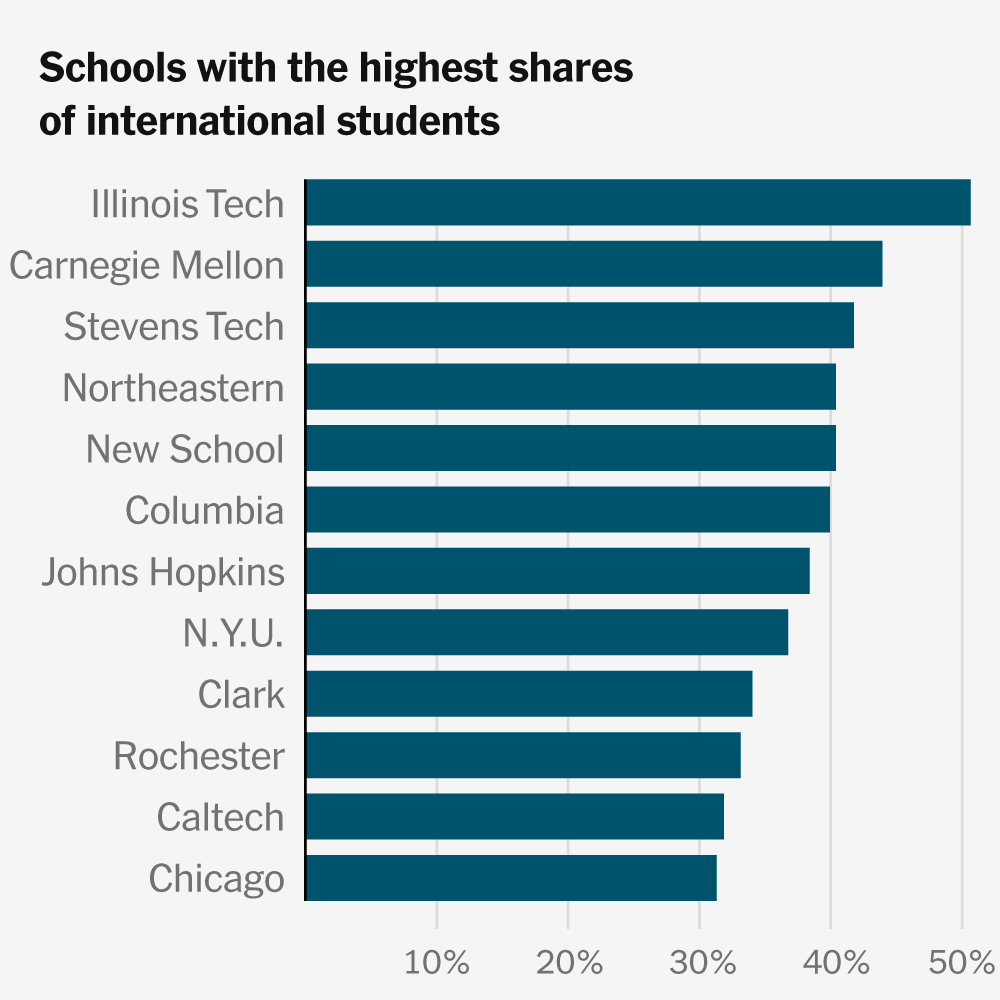
This incident also highlights the risk that other universities face from an administration that has shown hostility towards higher education. In fact, universities such as N.Y.U., Johns Hopkins, Columbia, and Carnegie Mellon have even larger shares of international students than Harvard does. This metric, which was once seen as a reflection of their international renown and financial strength, is now seen as a vulnerability.
The number of international students studying at these colleges and across the United States has been steadily increasing over the past two decades. This is due to rising incomes in countries like China and India, which have led to more families seeking to educate their children in America. Domestic factors have also played a role, as public research universities have turned to international students to help offset declines in state funding for education.
Economist Gaurav Khanna, who has studied these shifts in higher education, explains that while there is currently a lot of debate about trade deficits with China, the United States actually has a surplus in services such as higher education. This is because international students contribute a significant amount of money to the U.S. economy, with over 1.1 million students contributing about $43 billion during the 2023-24 academic year.
In contrast, U.S. students often receive financial aid directly from universities or other federal programs, and at public universities, they may pay lower in-state tuition. This means that international students end up contributing more in tuition dollars than their American counterparts. Mirka Martel, head of research, evaluation, and learning at the Institute of International Education, explains that this higher tuition paid by international students helps subsidize lower costs for U.S. students. In some cases, international students may even pay a higher tuition rate than regular out-of-state students.
For universities, a decline in international students could have serious financial consequences, in addition to disrupting classrooms, research, and the future workforce in the United States. Even without the threat that Harvard faced, colleges and universities were already preparing for a potential decline in international students due to the Trump administration’s policies.
Source:Read More